
Are Consultants a Threat to Your Team? Debunking the Biggest Myths in Kenya’s Consulting Industry
Why Many Businesses Hesitate to Bring in Consultants
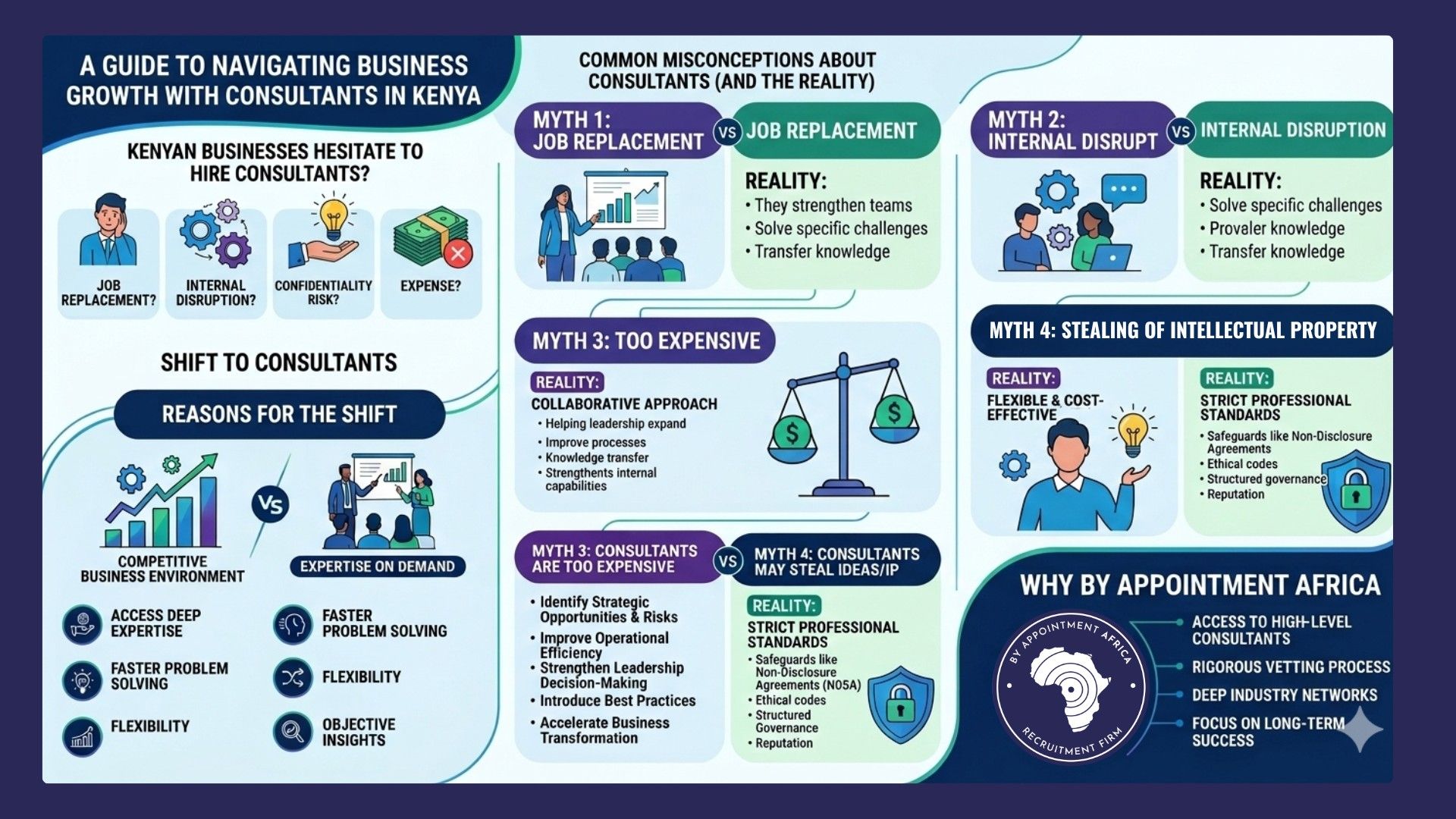
Across Kenya, many business owners recognise the value of specialised expertise. Yet when the topic of hiring a consultant arises, hesitation often follows.
Common concerns include:
- Will a consultant replace someone on the team
- Will they disrupt internal processes
- Could they take confidential knowledge elsewhere
- Are consultants simply too expensive
These fears are understandable, particularly for founder led companies and growing organisations that have built their teams carefully.
In reality, professional consulting works very differently. When engaged correctly, consultants strengthen teams, accelerate growth and provide expertise that may not exist internally.
In this article, we address the most common misconceptions about consultants in Kenya and explain how businesses can benefit from working with the right consultancy partner.
Why Kenyan Businesses Are Increasingly Turning to Consultants
The business environment in Kenya has become more competitive and fast moving. Organisations are expected to adapt quickly, improve efficiency and make strategic decisions that support long term growth.
Many companies are therefore shifting towards an expertise on demand model.
Instead of hiring permanent executives for every function, businesses increasingly engage consultants for specialised projects, strategic initiatives or leadership guidance.
- Access to experienced professionals with deep industry expertise
- Faster problem solving and implementation
- Flexibility without increasing long term payroll costs
- Objective insights from outside the organisation
For many companies, consultants act as strategic partners who help leadership teams navigate complex challenges.
Myth 1: Consultants Will Take Someone’s Job

One of the most common fears is that consultants are brought in to replace existing employees.
In reality, consultants are rarely hired to eliminate roles. Their purpose is usually to solve a specific challenge, introduce new expertise or support internal teams during periods of change.
Examples include:
- Supporting leadership during business expansion
- Improving operational processes
- Advising on strategy, finance or marketing
- Guiding transformation or restructuring projects
Rather than replacing employees, consultants often empower teams by transferring knowledge, introducing new systems and strengthening internal capabilities.
A strong consultancy engagement should leave the organisation more capable than before.
Myth 2: Consultants Disrupt Internal Teams

Another concern is that consultants may undermine internal leadership or disrupt the existing culture.
This risk usually arises only when consultants operate without alignment or communication with management.
Professional consultants work collaboratively with leadership teams, HR departments and key stakeholders. Their role is to support decision makers, not compete with them.
Effective consultants:
- Respect organisational structures
- Work closely with HR and department heads
- Share insights openly with leadership
- Align recommendations with the company’s strategy
When managed correctly, consultants complement internal teams rather than challenge them.
Myth 3: Consultants Are Too Expensive for Most Businesses

Many organisations assume that consultants are only affordable for large corporations.
In practice, consulting engagements are often far more flexible than people expect.
Consultants can be hired through several models:
- Project based engagements
- Strategic advisory retainers
- Performance based arrangements
- Short term specialised assignments
For many businesses, hiring a consultant for a defined project is significantly more cost effective than recruiting a full time senior executive.
This allows companies to access high level expertise only when it is needed.
Myth 4: Consultants May Steal Ideas or Intellectual Property

Confidentiality is a legitimate concern, particularly for businesses developing new strategies, products or internal systems.
However, reputable consultants operate under strict professional standards and confidentiality agreements.
Trustworthy consultancy firms implement safeguards such as:
- Non disclosure agreements
- Ethical codes of conduct
- Structured project governance
- Strong reputation within the industry
Consultants depend heavily on credibility and long term relationships. Protecting client confidentiality is essential to maintaining that trust.
What a Professional Consultant Actually Brings to Your Business
When businesses partner with the right consultancy firm, the value extends far beyond advice.
Experienced consultants can help organisations:
- Identify strategic opportunities and risks
- Improve operational efficiency
- Strengthen leadership decision making
- Introduce industry best practices
- Accelerate business transformation
They provide an objective perspective that internal teams may not always have.
This combination of external insight and practical experience often leads to more effective decision making.
Why Work With By Appointment Africa for Consultancy Support
Choosing the right consultancy partner is critical.
By Appointment Africa has more than three decades of experience working within the East African business environment and specialises in identifying highly qualified consultants and executives for organisations across the region.
The firm focuses on carefully matching expertise to business needs through a structured, research driven approach. This ensures organisations gain access to professionals who not only possess the right technical skills but also align with company culture and leadership objectives.
Key advantages include:
- Access to highly qualified C level consultants
- Rigorous vetting and assessment processes
- Deep networks across multiple industries
- A focus on long term organisational success
This approach allows businesses to bring in trusted expertise while maintaining stability within their teams.
Final thoughts
Consultants are not a threat to your team. When engaged strategically, they become an extension of your leadership capabilities.
They bring fresh thinking, specialised knowledge and practical experience that help businesses navigate complex challenges.
For companies in Kenya looking to grow, innovate or improve performance, the right consultant can be a powerful asset.
Need expert support for your next business challenge?
By Appointment Africa connects organisations with experienced consultants and senior professionals who can help solve complex problems and drive growth.
Contact the team today to explore how the right consultant can support your organisation’s next stage of success.
Final thoughts
How much does it cost to hire a consultant in Kenya?
Consulting fees vary depending on the scope of the project, the level of expertise required and the engagement model. Many consultants offer project based or performance based arrangements that allow businesses to manage investment more effectively.
Is it better to hire a consultant or a full time executive?
This depends on the nature of the business challenge. Consultants are ideal for specialised expertise, strategic guidance or short term projects. Full time executives are better suited for ongoing leadership responsibilities.
Are consultants only useful for large companies?
No. Many small and medium sized businesses benefit from consultants because they provide access to expertise that may not exist within the organisation.